
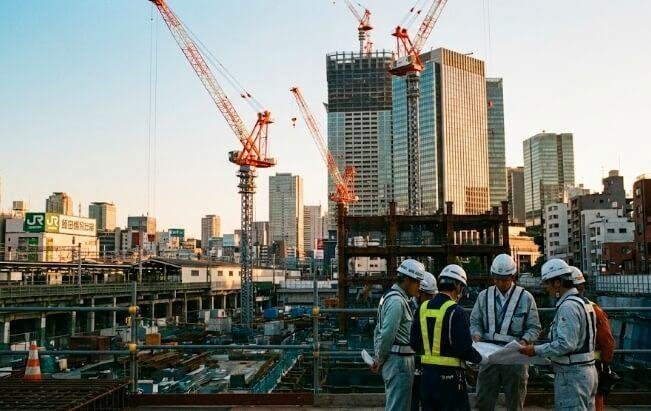
Japan's construction sector is short of people for a structural reason — the workforce is ageing faster than it is being replaced, with around 35.5% of construction workers aged 55 or older as of 2021, against only about 12% under 29. That is the demand story in a single line. The more useful question, and the one this article answers, is a different one: what would an Indian civil engineer actually do in Japan? “Civil engineering jobs in Japan” is not one job. It is four broad lanes, each with its own daily work, its own level of demand, and its own entry conditions. Understanding which lane fits you is the difference between a vague ambition and a real plan.
1. Design and structural engineering
This is the lane closest to what most Indian civil-engineering graduates already study. The work sits inside construction consultancies and design firms: structural analysis, calculations, preparation of design drawings, and technical reporting. Japan's immigration authority explicitly recognises “research, analysis and structural design at a civil engineering or construction consulting firm” as approved professional work for a foreign engineer, so the visa route matches the job description cleanly.
Demand in this lane is steady. Japan is shifting from building new infrastructure toward inspecting, renewing and extending the life of what already exists — bridges, tunnels, water systems built decades ago. That maintenance-and-renewal work keeps design and analysis teams busy, and it rewards engineers who understand seismic design and Japanese structural codes. The trade-off is that this is also the lane where Japanese language matters most early on, because design review and documentation happen in Japanese.
2. Site supervision and construction management (Sekō Kanri)
Sekō kanri is the backbone role of Japanese construction. It covers site supervision, scheduling, quality control, safety management and coordination between the design office and the workers on site. Immigration guidance treats “preparation of construction drawings and on-site supervision of skilled workers” as professional engineering work — which is worth stating plainly, because supervising a site is permitted on an engineer visa, while performing the manual construction labour itself is not. They are different jobs on different visas.
Demand here is arguably the sharpest of all four lanes, precisely because the ageing workforce problem hits site leadership hardest. There is a formal ladder attached to it: the national qualification Doboku Sekō Kanri Gishi (civil engineering construction management engineer), which Japanese employers list directly in their hiring requirements. Foreign nationals are eligible to sit for it, and overseas degrees and work experience can be assessed toward the entry requirements.
The honest caveat: this is not a quick win. The qualification requires documented practical experience and is examined in Japanese, so it is realistically a goal for years two to five of a career in Japan, not something you arrive holding. Engineers usually enter as assistant site engineers first and build toward it.
3. BIM and CIM — digital engineering
One point of vocabulary first, because it trips up nearly every applicant: in Japan, BIM generally refers to building projects, while CIM — Construction Information Modeling — is the term used for civil engineering and infrastructure work. Job listings for civil roles will often say BIM/CIM together.
This lane exists because of policy, not fashion. Through its i-Construction initiative launched in 2016, Japan's Ministry of Land, Infrastructure, Transport and Tourism (MLIT) set out to lift construction productivity using digital tools, and from fiscal 2023 the ministry applied BIM/CIM in principle to the public infrastructure projects it directly manages. The effect on industry is measurable: BIM adoption among Japanese construction firms rose from 48.4% in 2022 to 58.7% in 2024.
For an Indian engineer, this is a genuinely favourable lane. The day-to-day work — 3D modelling, clash detection, quantity extraction, coordinating model data across design and construction — is software-led and internationally standardised, which means technical competence carries more weight relative to language than it does in a purely Japanese design office. It is also the newest lane, so the pool of engineers with real BIM/CIM experience is smaller than the demand for them. That said, this is an advantage, not an exemption: the language expectation does not disappear, it simply arrives a little later.
4. Project management, cost and consulting
The fourth lane is the commercial and coordinating side of a project. It includes cost estimation, quantity surveying, survey and feasibility analysis, procurement coordination, and client-facing project management — with “building cost estimation work at a construction company” among the roles immigration guidance recognises. Senior careers here run toward the Kanri Gijutsusha (managing engineer) responsibilities that Japanese contractors are legally required to staff on larger works.
Demand exists, but be realistic about the entry point. This lane is the most language-intensive of the four, because it is built on negotiation, documentation and client communication. Most foreign engineers reach it after establishing themselves in design, site or digital work first, rather than entering directly.
Which lane fits you?
A rough but useful sorting. If you are a recent graduate with strong software skills, BIM/CIM is usually the most accessible entry point. If you already have site experience in India, sekō kanri is the natural continuation and carries the clearest long-term qualification ladder. If your background is design and analysis, consultancy work maps most directly onto your degree. Project management and cost roles are best treated as a destination rather than a starting line. Across every lane, Japanese ability governs how fast you progress — workplace expectations generally sit around JLPT N2, and since April 2026 certain engineer-visa applicants must also demonstrate language ability at CEFR B2 level. Preparing for the right lane before you apply is where the groundwork happens, and it is the stage Bhrighu's Japan pathway programme is built around: language, BIM/CIM readiness, and understanding Japanese workplace expectations before you arrive.
The constraints worth knowing
None of these lanes is a shortcut. Japanese national qualifications take years of documented experience and are examined in Japanese. BIM/CIM demand is growing steadily, but it is not unlimited, and it does not remove the language requirement. Roles vary considerably between a large general contractor, a design consultancy and a mid-sized firm, so two jobs with the same title can look very different in practice. What is true across all four is that Japan needs qualified civil engineers, and that the work on offer is professional engineering work, not manual labour.
Choosing your starting point
The strength of Japan's civil engineering market for Indian engineers is that there is more than one way in. Design, site management, digital engineering and project delivery each reward a different profile, and a career that begins in one lane frequently moves across the others. The task now is simply to identify which lane your background actually fits, and prepare for that one properly. If you want to talk it through against your own qualifications and experience, Bhrighu's counsellors and its structured pathway programme can help you work out a realistic starting point.